Remote and Keypad Faults
Remote controls and wireless keypads are checked for battery condition, programming, signal response, worn buttons, and compatibility with the receiver.
Serving Fort Meade, Florida
Restore dependable access with careful troubleshooting of remotes, keypads, safety sensors, wiring, controls, drive systems, and opener motors.
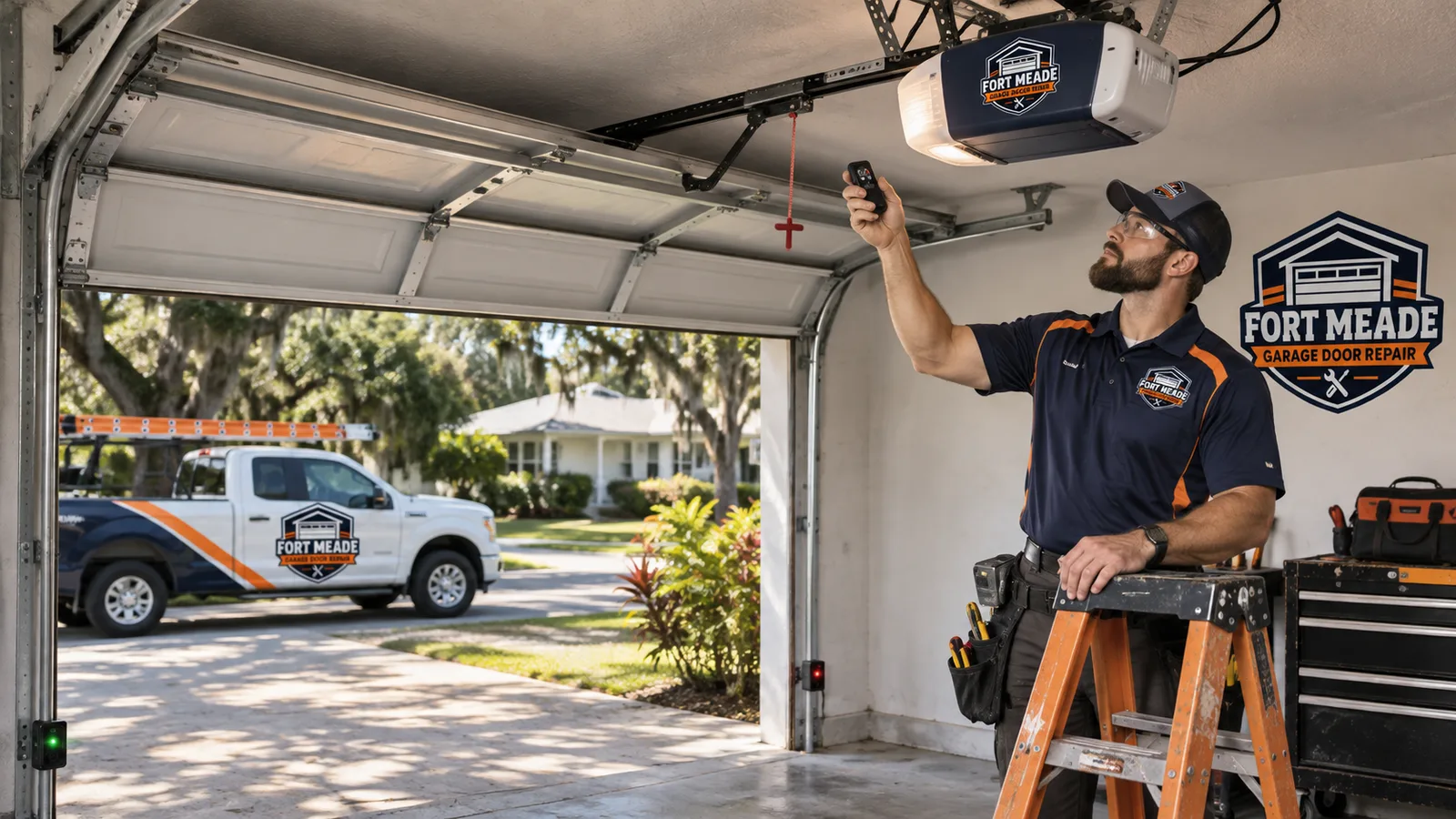
When the door will not open, reverses unexpectedly, or responds only some of the time, garage door opener repair in Fort Meade, FL starts with a complete check of the operating system. Fort Meade Garage Door Repair examines the symptoms, tests the controls, and traces the fault before recommending a repair.
Fort Meade Garage Door Repair has garage door specialists serving Fort Meade who work on the connected parts that control powered access: handheld remotes, wall consoles, wireless keypads, photo-eye sensors, limit settings, travel controls, wiring, drive components, and motor units. The goal is to identify whether the trouble comes from the opener itself or from a condition that prevents the opener from moving the door correctly.
Central Florida heat, humidity, thunderstorms, and wind-driven rain can be hard on electronics and exposed connections. Outdoor keypads may develop worn contacts, sensor brackets can shift, and power interruptions may clear programmed settings. A direct diagnosis separates those issues from mechanical resistance in the door.
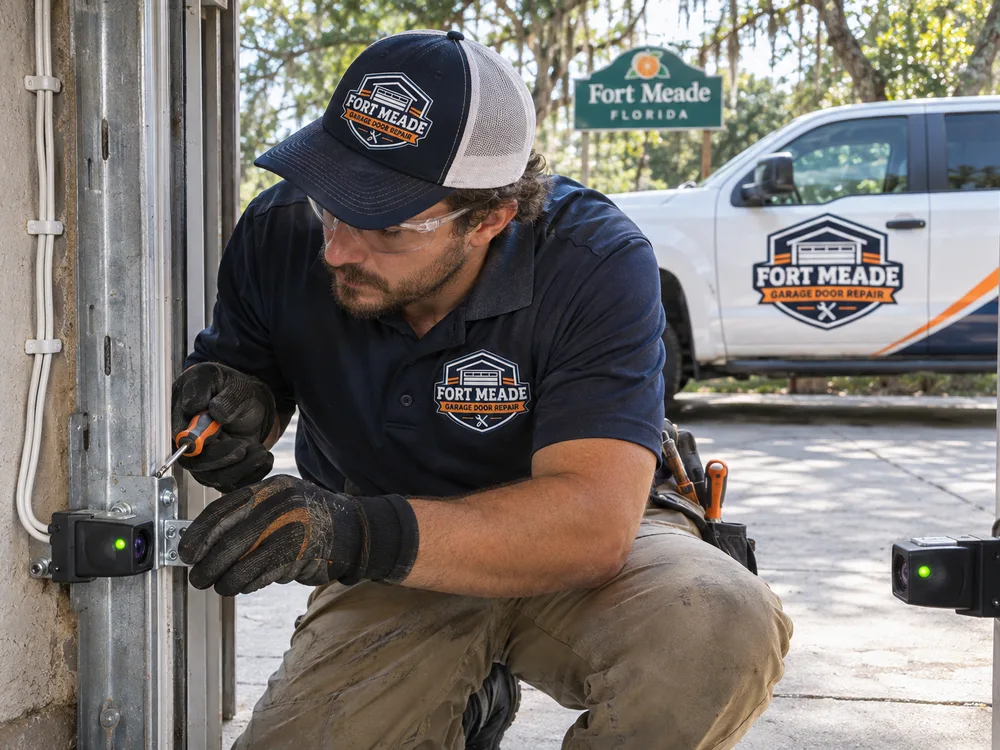
A door that refuses to close often points to the safety-reversal system. The two photo eyes near the floor must face each other across the opening. A bent bracket, blocked lens, dirty lens, loose wire, or direct sunlight at the wrong angle can interrupt the beam. The opener may then reverse the door or flash its lights to report a fault.
If the wall control works but a remote does not, the likely causes include a depleted battery, lost programming, damaged remote buttons, or a failed receiver. When neither control works, the power supply, wall-console wiring, logic board, or motor unit needs testing. A keypad that accepts a code but does nothing may need reprogramming, a new battery, or replacement after its contacts fail.
Grinding, humming, or movement that stops partway can involve the drive system, travel limits, force settings, motor gears, or a door that is binding. The door should be checked by hand with the opener disconnected. A balanced door should move smoothly and remain near a partially open position. A heavy or rapidly falling door indicates a separate mechanical concern that should be addressed before the opener is put back into service.
Remote controls and wireless keypads are checked for battery condition, programming, signal response, worn buttons, and compatibility with the receiver.
Photo-eye lenses, brackets, indicator lights, low-voltage wiring, and alignment are inspected when the door reverses or will not close.
Chain, belt, or screw-drive movement is observed for slipping, binding, damaged gears, excessive slack, and abnormal motor noise.
The wall console, terminals, connections, and visible wiring are tested when commands are intermittent or the opener appears unresponsive.
Open and close limits are adjusted only after the door and drive system are checked. Excess force must never be used to mask resistance.
Power input, error indicators, receiver response, and control-board behavior are evaluated after outages, surges, or unexplained operation.
Step 1 of 5
Fort Meade Garage Door Repair begins with what the opener does, when the problem started, and whether the wall control, remote, or keypad behaves differently.
Step 2 of 5
The opener is disconnected so the door can be moved by hand. The technician then checks the drive rail, trolley, controls, sensors, wiring, settings, and motor unit.
Step 3 of 5
Operational tests narrow the problem to the affected component or adjustment. If the door itself is too heavy, uneven, or binding, that condition is identified before opener work proceeds.
Step 4 of 5
The recommended work is discussed based on the diagnosis, the opener's condition, and parts availability. Replacement may be considered when repair is impractical or several major components have failed.
Step 5 of 5
After approved work, the door is cycled through full travel. Remote response, keypad operation, limits, photo-eye interruption, and the safety-reversal function are checked.
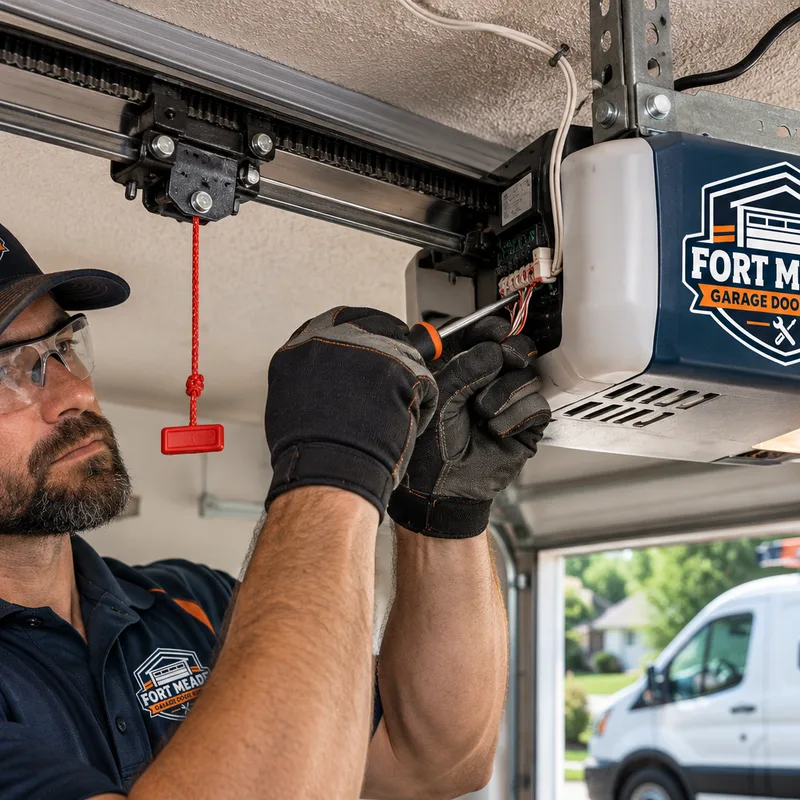
Repair is often reasonable when the opener is otherwise sound and the failure is limited to a sensor, remote, keypad, wall control, wiring connection, gear, or setting. Replacement may make more sense when a motor unit has repeated faults, major components are unavailable, or the repair would leave an aging system with other likely failures.
Safety is also an important factor. Modern residential openers use photo-eye sensors near the floor and an automatic reversing function. An opener that cannot pass reversal testing should not remain in normal use. A technician can explain whether an adjustment or component repair restores proper operation or whether replacement is the safer route.
Horsepower or horsepower-comparable ratings must match the door rather than compensate for a door that is difficult to lift. The opener moves the door, but the spring system supports its weight. Installing a stronger motor does not correct a poorly balanced or binding door.
Intermittent opener problems usually become more disruptive with time. Arrange a diagnosis while the symptoms can still be observed and tested.
CALL NOW: (863) 285-3637The opener is often responding to an interrupted safety beam or unexpected resistance. In Fort Meade garages, dust, moisture, a shifted photo-eye bracket, loose low-voltage wiring, or strong sunlight on a sensor can affect the beam. The lenses, alignment, indicator lights, wiring, tracks, and door movement should be checked before force settings are changed.
Yes, intermittent remote operation can be diagnosed by checking the battery, button contacts, programming, antenna, radio interference, and opener receiver. If the wall console works consistently, that helps narrow the fault to the remote or wireless receiver rather than the motor.
A humming opener may have a jammed drive, damaged internal gear, failed capacitor, stalled motor, or a door that is too difficult to move. Stop repeated attempts because a stalled motor can overheat. The door should be disconnected and tested by hand before the opener is run again.
Sometimes, depending on which component failed. A power interruption may require reprogramming, while an electrical surge can damage a logic board, transformer, receiver, or connected accessory. Central Florida storms make power-related symptoms relevant, so the outlet, breaker, opener lights, error codes, controls, and board response should all be tested.
Many isolated faults can be diagnosed and repaired during one service visit, but the exact time depends on the problem and parts availability. Sensor alignment or programming is generally faster than tracing intermittent wiring or replacing an internal drive component. The technician can give a clearer timeline after testing the opener.
No, a powered garage door should not be used normally when its photo-eye system or automatic reversal function fails testing. These safeguards are intended to stop or reverse a closing door when an obstruction is detected. Fort Meade Garage Door Repair can inspect the sensors, wiring, settings, and door movement to identify the fault.
That pattern usually points to a wireless-control issue rather than a total opener failure. Possible causes include dead batteries, erased programming, a locked wall-console setting, incompatible replacement controls, antenna trouble, or a receiver fault. Testing each control separately helps isolate the cause.
No, a stronger opener is not the proper correction for a heavy garage door. The spring system should counterbalance the door so it can move smoothly by hand. If the door drops, binds, or requires substantial lifting force after the opener is disconnected, the mechanical condition must be corrected before opener operation resumes.
Tell Fort Meade Garage Door Repair what the opener is doing, which controls still work, and when the trouble began. A focused inspection can identify the fault and establish a clear repair plan.